Oct 2026



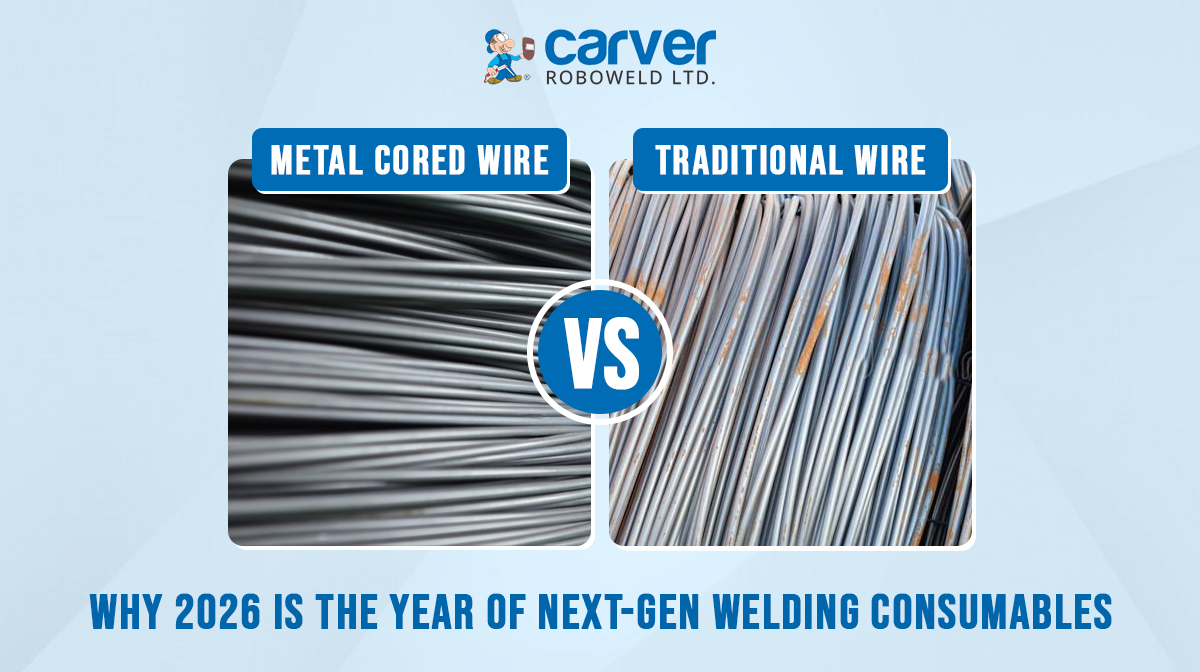
At Carver Roboweld, we spend our days around welding stations, both the ones operated by hand and the ones run entirely by robotic arms, and over the last couple of years we have watched the same pattern repeat itself across forging units in Rajkot and beyond. Shops that switch from conventional flux cored wire to metal cored wire don’t just save a little money, they end up rethinking how their entire weld cell operates. As we move deeper into 2026, that pattern has turned into a genuine shift in the industry, and we wanted to put down in writing why we believe metal cored wire has stopped being a niche upgrade and has become the sensible default for forging die welding.
To understand why metal cored wire performs so differently from flux cored wire, it helps to look at what’s actually packed inside it. A metal cored wire is built chiefly from alloying elements such as manganese, silicon, and depending on the application, nickel, chromium and molybdenum, along with small amounts of arc stabilizers like sodium and potassium, with the remaining volume filled by iron powder.
This composition is formulated in smaller, more targeted batches than the large heats used for solid wire, which allows manufacturers to tune the alloy for a specific job rather than offering one generic blend for everything. That’s how compositions employing chromium, nickel and molybdenum, including austenitic and ferritic stainless steel alloys, have become available for specialised forging and fabrication needs. Flux cored wire, by contrast, relies on a slag-forming flux to protect and shape the weld, and that slag is exactly where a large share of the wasted material and the extra cleanup time comes from.
Every welding consumable loses some material to slag, spatter and fume, and the portion that actually ends up as usable deposited weld metal is called deposition efficiency. Flux cored wires typically sit in the 84 to 89 percent range depending on wire diameter and slag volume, which means a meaningful chunk of every kilogram purchased never becomes part of the finished part. Metal cored wire, because it behaves much closer to a solid MIG wire with very low spatter and minimal slag, delivers deposition efficiency in the 92 to 98 percent range. When you carry that difference through an entire production run at a forging die operation, it shows up as cost savings of roughly 12 to 14 percent, and it’s a saving that comes purely from wasting less, not from cutting corners anywhere in the process.
Beyond efficiency, there is a production story that matters just as much to us at Carver Roboweld. Units running metal cored wire have reported an average 40 percent increase in production, driven by higher duty cycles, faster travel speeds and a deposition rate that stays strong even at equal current levels. That last point ties into current density: metal cored wire carries a higher current density than conventional flux cored wire, so it deposits more metal per amp, which quietly translates into a large saving on power consumption as well. Add to that a lower slag formation and a lower defect rate, and the result is less time spent reworking parts off the line and more stampings coming out of every welded forging die without needing a second pass.
Since our name carries “Roboweld,” this point matters to us more than most. Metal cored wire is designed to be used in any position, whether that’s a welder working by hand on the shop floor or a fully automated weld station running unattended cycles. That flexibility means a forging unit doesn’t need to maintain two separate consumable systems as it gradually brings robotic welding into parts of its process. The wire that works in the automated cell today is the same wire that works in a manual repair job tomorrow, and that consistency simplifies inventory, training and quality control all at once.
There’s also a straightforward human benefit here that we don’t want to gloss over. Lower fume generation and reduced spatter make metal cored wire genuinely eco-friendlier to the welding area, which means a healthier work environment for the people standing at the station for hours at a time. In an industry where worker wellbeing is increasingly scrutinised by customers and auditors alike, this isn’t a small footnote, it’s a real operational improvement.
Metal cored wires were first introduced to the Indian market by Carver Welding Private Ltd., formulated specifically for forging industry applications after extensive research, development and rigorous testing, and manufactured in world class, ISO 9001-2015 certified facilities in Rajkot, Gujarat, with strict quality control from raw material selection through to the finished product. As Carver Roboweld, our focus is on making sure this same consumable performs just as reliably in automated weld stations as it does in hand held operations, since that’s where forging units are increasingly headed. The wire is available in 100 kg organic material drum packing for longer uninterrupted runs, as well as 25 kg spools for more conventional setups, so switching over doesn’t require reworking existing equipment.
If your unit is still running conventional flux cored wire on its forging die welding lines, the case for change in 2026 isn’t built on one dramatic number. It’s built on cost, output, power, consumables and worker health all moving in the same direction at the same time, and that alignment is exactly why we believe metal cored wire is no longer the alternative option, it’s becoming the standard one.