Aug 2026



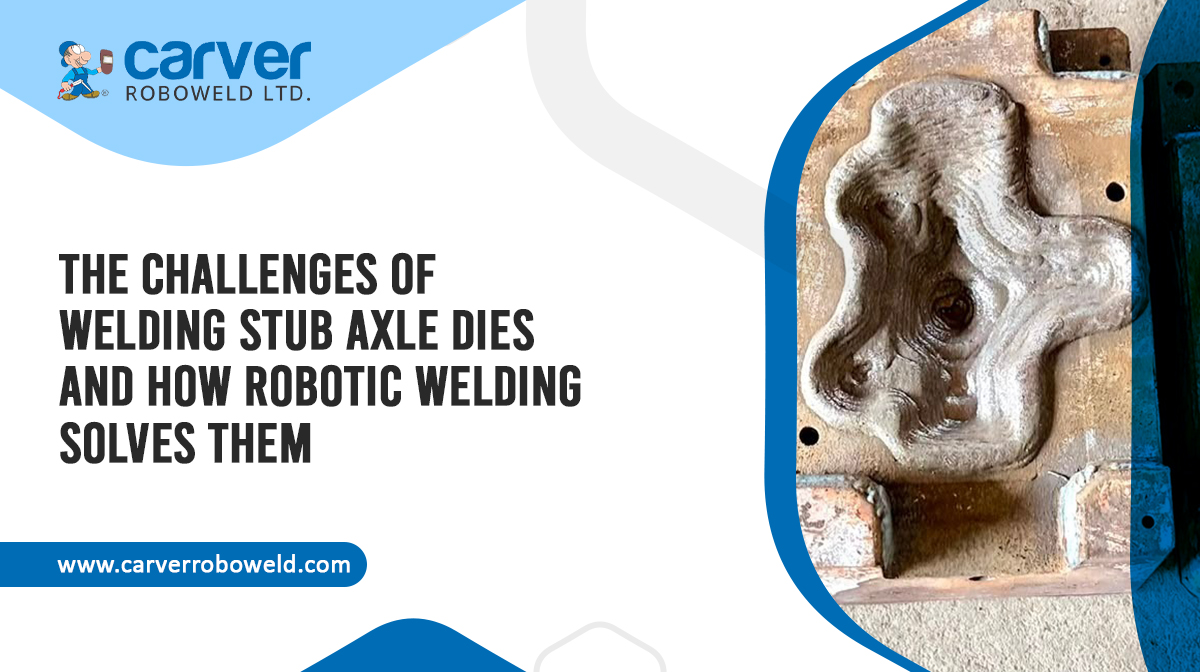
Stub axle dies work in an unforgiving environment. During automotive forging, these precision tools are exposed to extreme pressure, repeated impact, high temperatures and constant abrasion. Over time, this can result in wear around critical profiles, surface damage, cracks, deformation and loss of dimensional accuracy.
Replacing a damaged die is not always the most practical answer. Stub axle die repair, die regeneration and weld build up can extend usable tool life and reduce production disruption. However, welding a forging die is a highly specialised process. If welding parameters, heat input or deposition paths are not controlled accurately, a repair can create further problems rather than solve the original one.
This is where robotic welding for forging dies offers a major advantage.
At Carver Roboweld, precision engineering services include forging dies and die regeneration, CNC machining and robotic welding solutions capabilities that support a more controlled approach to tool restoration and production welding.
1. Maintaining Dimensional Accuracy
A stub axle is a safety critical automotive component, and the forging die must produce consistent profiles repeatedly. Even minor wear or incorrect weld build up on the die cavity can affect the final forging geometry.
During manual die welding, maintaining a uniform layer across complex surfaces can be difficult. Differences in torch angle, travel speed, arc length and operator technique can cause uneven deposition. This may leave excess material in one area and insufficient build up in another, increasing the machining effort required after welding.
For manufacturers, this makes precision die welding essential; not optional.
2. Managing Heat Input and Distortion
Forging dies are commonly made from high performance tool steels designed to withstand demanding conditions. Yet these materials require careful heat management during welding. Excessive or inconsistent heat can create a large heat affected zone, increase the risk of distortion and affect the properties of the repaired area.
The challenge is to deposit enough weld material for effective die regeneration while avoiding unnecessary thermal stress. Inconsistent heat input can also make it harder to achieve predictable results from one repair to the next.
3. Reducing the Risk of Cracks and Defects
Cracking, porosity, lack of fusion and incomplete weld coverage can compromise a repaired die. These issues may not always be visible immediately, but they can reduce die life and lead to unplanned maintenance later in the forging process.
Manual welding depends heavily on the consistency of the individual operator, especially when repairing detailed die profiles or repeating the same repair across multiple dies. A reliable stub axle die welding process must control weld parameters closely and apply them consistently.
4. Achieving Repeatable Weld Build Up
Die repair is not simply about adding metal back to a worn surface. The weld deposit must be placed exactly where it is needed, with the right coverage and controlled overlap. The aim is to create a stable foundation for subsequent CNC machining, finishing and inspection.
When production volumes are high, repeatability becomes even more important. A process that varies from shift to shift can lead to inconsistent die quality, variable repair time and unpredictable costs.
5. Improving Productivity Without Sacrificing Quality
Manual welding can be effective for certain jobs, but repetitive die regeneration can be time intensive. Skilled welders may spend considerable time performing build up work, while production teams wait for the die to return to service.
The challenge is to improve turnaround time without compromising weld quality, die accuracy or durability.
Consistent Welding Parameters
A robotic welding cell can follow programmed weld paths with controlled travel speed, torch position, arc settings and overlap. This reduces variation in the weld build up process and helps deliver more uniform deposition across the die surface.
For stub axle dies, this consistency supports better control over the repaired profile before machining.
Accurate Coverage of Complex Die Areas
Complex die shapes demand controlled torch movement. Robotic welding systems can be programmed to follow repeatable paths around contours, worn sections and targeted build up zones. This is particularly valuable where manual access is difficult or where a repair must be repeated across multiple similar dies.
The result is a more dependable automated welding solution for forging die regeneration.
Better Repeatability From Die to Die
Robotic welding does not replace engineering judgement; it makes a proven process more repeatable. Once the appropriate welding procedure and deposition strategy are established, the same programmed sequence can be used consistently for comparable die repairs.
This helps manufacturers standardise forging die repair, reduce process variation and improve confidence in the finished tool.
Efficient Integration With Machining and Finishing
After weld builds up, repaired dies often require machining to restore their final dimensions and surface condition. Combining robotic welding with CNC machining creates a more connected repair workflow: weld material is deposited accurately, then machining brings the die back to the required profile.
Carver Roboweld’s combined focus on forging die regeneration, robotic welding and CNC machining supports this type of precision led manufacturing approach.
The Smarter Route to Longer Die Life
Stub axle die welding is a balance of metallurgy, geometry, heat control and process consistency. Poorly controlled repairs can create distortion, defects and costly rework. A properly planned robotic welding process, however, can improve weld consistency, reduce manual variation and support efficient die restoration.
For forging companies looking to strengthen their stub axle die repair, robotic die welding, weld build up and die regeneration capabilities, automation offers a practical route to improved quality and repeatable performance.