Oct 2026



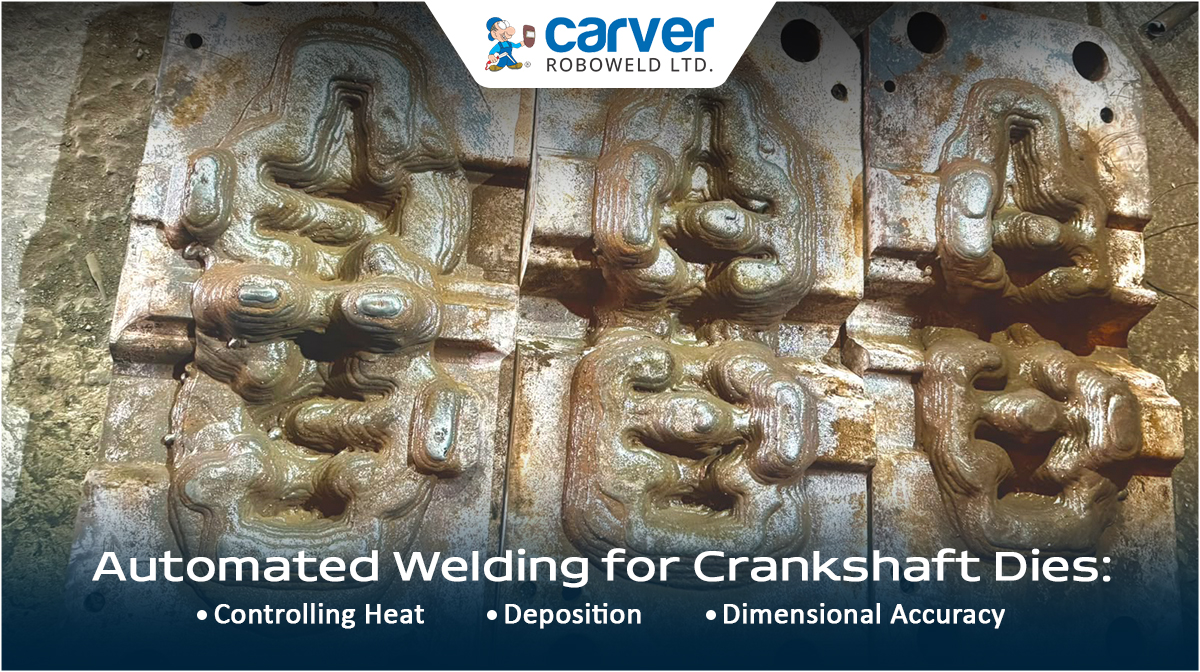
Crankshaft dies operate under intense forging conditions. They must repeatedly shape metal into complex crankshaft geometries while resisting high pressure, heat, impact and abrasive wear. Over time, even high quality forging dies can develop worn cavities, damaged edges, surface defects and areas that no longer meet the required profile.
For manufacturers, the issue is not simply whether a crankshaft die can be repaired. The real question is whether it can be restored with the accuracy, strength and consistency needed to return it to production with confidence.
That is why automated welding for crankshaft dies has become an important part of modern forging die regeneration. By controlling heat input, weld deposition and programmed welding paths, robotic systems can help create a more repeatable repair process than conventional manual build up alone.
At Carver Roboweld, forging die regeneration, CNC machining and robotic welding solutions are brought together to support precision led manufacturing and die restoration.
Crankshaft forging dies contain detailed cavities and critical working surfaces. These features must produce components accurately, repeatedly and reliably. When a die is worn or damaged, welding is often used to rebuild the affected area before machining restores the final geometry.
However, crankshaft die repair welding brings several technical challenges.
Heat is necessary for welding, but too much heat or heat applied inconsistently can create problems. Excessive thermal input may increase distortion, affect surrounding material and produce unwanted stress within the die.
For high performance forging dies, the goal is not simply to deposit more weld metal. It is to apply the correct amount of energy in the correct area, using a controlled process that supports the integrity of the die.
A well planned robotic welding process helps maintain consistent welding parameters, including torch movement, travel speed and weld sequence. This gives manufacturers more control over heat input during die regeneration.
During die repair, weld build up must be applied evenly across the damaged or worn zone. Uneven weld layers can create unnecessary machining work, increase material usage and make it more difficult to achieve the required final dimensions.
Manual welding can depend on operator technique, access to the workpiece and the complexity of the die surface. Automated welding introduces a programmed, repeatable path. The robotic system can place weld beads with controlled overlap and consistent spacing, helping create a more uniform build up.
For crankshaft dies, where precision is central to forging quality, controlled deposition supports a more efficient restoration process.
A repaired die must ultimately return to its intended working profile. Even small variations in the die cavity can affect the forged component, increase finishing requirements or lead to inconsistent production output.
This is why robotic die welding and CNC machining work so effectively together. Automated welding deposits material where it is required; CNC machining then removes material accurately to restore the die’s working dimensions and surface profile.
The result is a more structured workflow for crankshaft die regeneration:
Repeatable Welding Parameters
A robotic welding cell follows programmed instructions rather than relying solely on manual movement. This enables more consistent control of parameters such as weld travel speed, torch angle, bead overlap and deposition sequence.
For repeated crankshaft die repairs, that consistency can help manufacturers standardise their die welding process and reduce avoidable variation.
Accurate Welding on Complex Profiles
Crankshaft dies often feature contours, recesses and shaped surfaces that demand precise weld placement. Robotic welding can be programmed to follow these defined areas, helping target repair zones accurately and consistently.
This makes automated welding a valuable option for intricate forging die repair work where controlled weld coverage is required.
Reduced Rework and Better Material Control
When deposition is more uniform, there may be less excess weld material to remove during finishing. This can make downstream machining more efficient while supporting a cleaner, more controlled die regeneration workflow.
The aim is not simply faster welding. It is smarter welding using the right amount of material in the right location.
A Stronger Link Between Welding and Machining
Crankshaft die restoration is most effective when welding and machining are treated as connected stages rather than separate tasks. Carver Roboweld provides robotic welding, forging die regeneration and CNC machining capabilities, enabling a precision focused approach from weld build up through to final die finishing.
Automated welding gives forging manufacturers greater control over three areas that matter most in die repair: heat, deposition and dimensional accuracy. By improving consistency in weld build up, robotic welding can support better repair repeatability and a more reliable path back to production.
For companies seeking to improve crankshaft die welding, forging die repair, automated weld build up and die regeneration, the combination of robotic welding and precision CNC machining offers a practical solution.