



Real Case Studies: Robotic Welding Success Stories from Small & Large Manufacturers

Welding automation is not an idea for the future anymore, it is something that is really happening now. The number of stories about it just keeps growing. Lots of small companies are using robotic welding systems and it is making a big difference. They are getting work done making better products using their workers more wisely and being more competitive. All kinds of businesses from machine shops, to huge companies that make big machines and cars are seeing the real benefits. Here we are going to look at some examples of how robotic welding is changing the way things are made for both small and big companies. Welding automation and robotic welding are really making a difference.

Small Shop Success: Collaborative Robotics in Action

Siouxland Fabricating — Increased Productivity with Cobots

Siouxland Fabricating Inc. Is a company in Iowa that makes custom things. They have around 50 to 100 people working for them. The company had a problem that a lot of places have: they did not have skilled welders and they needed to get more work done without spending a lot of money on new equipment.

The company did not want to use the robots that you usually see in factories because these robots need a lot of time to be programmed and they take up a lot of space. So Siouxland Fabricating Inc. Decided to use welding robots, which are also called cobots.

They used the UR10e cobots with the BotX welding system. This really helped Siouxland Fabricating Inc. Because they were able to get rid of the bottlenecks, in their welding process their work started to flow better. The Siouxland Fabricating Inc. The company was able to improve their process flow a lot by using the cobots.

What made the difference? The system’s ease of use and intuitive setup meant welders could program and run the cobot without deep robotics expertise. This freed up welders for higher value tasks while the robot efficiently handled repetitive welds. The result was not only faster cycle times but a more flexible production environment that expanded capacity without hiring additional staff.

Processed Metal Innovators

In Wisconsin a company called Processed Metal Innovators had some problems. They did not have skilled welders working for them. Because of this they had to say no to work a lot. This was because they just did not have the people to do it. The old way of welding was not an option for them either. It was too expensive. It was not a good way to get things done when they had to make a lot of different things in small amounts. So Processed Metal Innovators started using robots called cobots like the UR10e, with BotX Welders. These robots helped them with welding tasks. They did not need to build safety walls around the robots or program them in a really specific way. Processed Metal Innovators used these cobots to automate their welding tasks. It worked out well for them.

The results were transformative: the company could quote more jobs, reduce lead times, and strategically scale operations without being bottlenecked by labor shortages. This is a powerful real world example of how automation can support, not replace, existing workforce capacity.

Machine Shop Integration — Safety and Efficiency Gains

There is a machine shop in Florida. This shop has about 50 to 60 employees. They made their work a lot better by using welding cells. These are called Motoman ArcWorld solutions. They are really good for welding things that’re hard to do and have to be done many times.

The shop used to do welding by hand for auger flights. This was very hard on the workers. It also made air that was not healthy to breathe. The workers were not very happy.

After they got the system the shop saw:

  • Significantly reduced exposure to welding fumes
  • Less physical strain on workers
  • Higher throughput with consistent weld quality
  • Improved air quality with integrated fume extraction
  • Robots didn’t just speed things up, they made the workplace safer and more sustainable for staff.
  • Scaling Up: Large Manufacturer Transformation

Kawasaki Motors Manufacturing

The Kawasaki Motors Manufacturing Corp in the United States has a great story about how they have been successful for a long time. They started using Kawasaki arc welding robots to make frames for all terrain vehicles and four wheelers over thirty years. Now robots do 80 percent of the welding work. This is because robots are good at doing welds that’re hard for people to do by hand or that do not turn out the same every time. Kawasaki Motors Manufacturing Corp uses these robots for welding because they are consistent and do a job. Kawasaki arc welding robots have been a help to the company.

Investing early in reliable robotics helped KMM maintain competitive production levels, dramatically reduce welding inconsistencies, and mitigate labor shortages. Over time, these robots have proven durable, reliable, and adaptable. A robot installed in 1997 ran more than 38,000 operating hours with minimal maintenance and was repurposed over years for different welding tasks.

Industrial Trailer Production

Titan Trailers, a manufacturer serving the hauling and earth moving sectors, also leveraged robotic arc welding to handle high volume production tasks. Automating welding for components like aluminum and steel couplers and swing door assemblies brought measurable improvements in both productivity and product quality. By integrating robotic systems capable of precise, repeatable welds, the company enhanced throughput and maintained design integrity across critical structural components improving customer satisfaction and operational margins in the process.

Common Themes Across Success Stories

1. Workforce Augmentation, Not Replacement

Robots are really helpful to manufacturers whether they are small or large. Robots do not take the place of workers, they just help them do their jobs better. The people who used to do the work now get to be in charge and make sure everything is okay. They check the quality of the work. Try to make the process better. Meanwhile the robots do the difficult tasks that people do not want to do. This way robotics helps the workforce, it does not replace the workforce.

2. Improved Quality and Consistency

Robotic systems do a good job of making welds that are the same every time and are of very high quality. This is something that’s very hard to do with manual methods especially when you are working with parts that have a lot of complicated shapes or when you have to make a lot of them. Automated welding helps to reduce the number of mistakes that are made. It makes you feel more confident that all of the products are going to be consistent. Robotic systems and automated welding are very good at doing this kind of work.

3. Scalability and Flexibility

From cobots in shops to fully integrated industrial cells in large factories robotic welding scales to fit the business needs of companies. Robotic welding can handle a lot of jobs with a small number of items and it can also handle big production runs with a lot of items. This means robotic welding offers a lot of flexibility to support the growth of companies like these and robotic welding is very good at this.

4. Mitigating Skilled Labor Shortages

The biggest benefit that keeps coming up is that it helps with the problem of not having experienced welders. When it gets really hard to find people who’re good at welding machines can help companies keep making things without sacrificing quality or missing deadlines. This is especially important for welding because it is very hard to find people who’re really good at it. Welding is a skill and when companies use machines to do the welding it helps them to keep producing things.

Robotic welding is no longer a futuristic dream; it’s a proven, ROI driven solution that’s reshaping how fabrication gets done. At Carver Roboweld, this shift is seen every day in real production environments, where tailored robotic welding solutions help both small machine shops and multinational manufacturers achieve measurable improvements in productivity, quality, and long term competitiveness that define modern manufacturing.
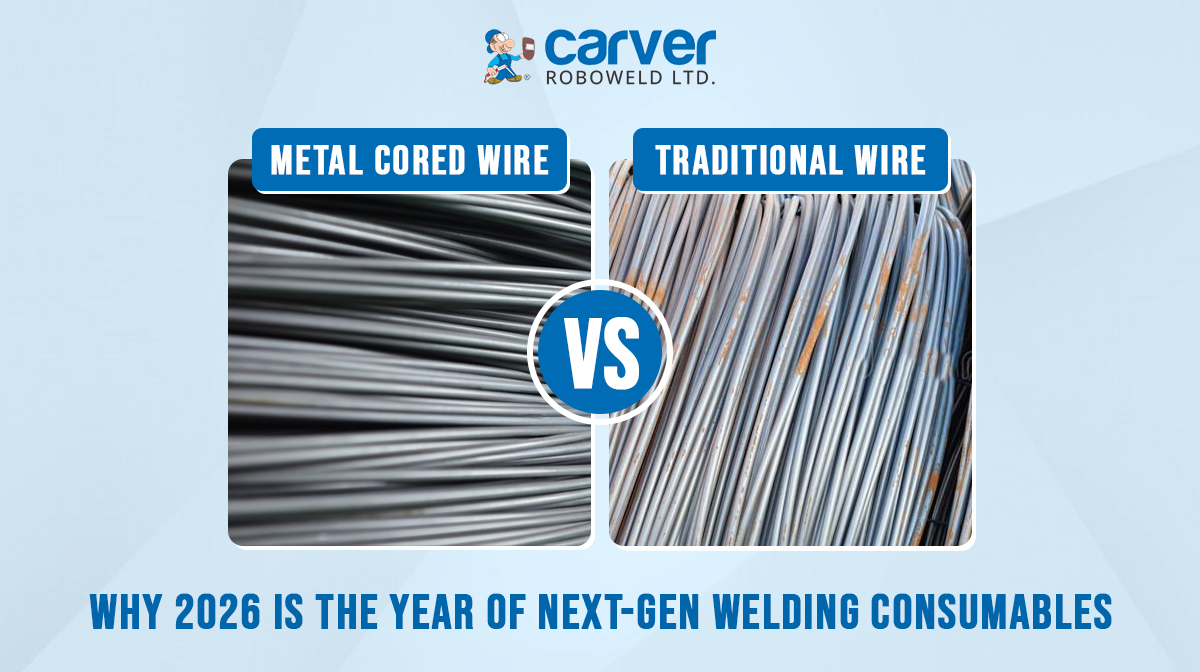
Metal Cored Wire vs Traditional Wire: Why 2026 Is the Year of Next-Gen Welding Consumables

At Carver Roboweld, we spend our days around welding stations, both the ones operated by hand and the ones run entirely by robotic arms, and over the last couple of years we have watched the same pattern repeat itself across forging units in Rajkot and beyond. Shops that switch from conventional flux cored wire to metal cored wire don’t just save a little money, they end up rethinking how their entire weld cell operates. As we move deeper into 2026, that pattern has turned into a genuine shift in the industry, and we wanted to put down in writing why we believe metal cored wire has stopped being a niche upgrade and has become the sensible default for forging die welding.

What Actually Happens Inside the Wire

To understand why metal cored wire performs so differently from flux cored wire, it helps to look at what’s actually packed inside it. A metal cored wire is built chiefly from alloying elements such as manganese, silicon, and depending on the application, nickel, chromium and molybdenum, along with small amounts of arc stabilizers like sodium and potassium, with the remaining volume filled by iron powder. 

This composition is formulated in smaller, more targeted batches than the large heats used for solid wire, which allows manufacturers to tune the alloy for a specific job rather than offering one generic blend for everything. That’s how compositions employing chromium, nickel and molybdenum, including austenitic and ferritic stainless steel alloys, have become available for specialised forging and fabrication needs. Flux cored wire, by contrast, relies on a slag-forming flux to protect and shape the weld, and that slag is exactly where a large share of the wasted material and the extra cleanup time comes from.

Deposition Efficiency Is Where the Real Savings Hide

Every welding consumable loses some material to slag, spatter and fume, and the portion that actually ends up as usable deposited weld metal is called deposition efficiency. Flux cored wires typically sit in the 84 to 89 percent range depending on wire diameter and slag volume, which means a meaningful chunk of every kilogram purchased never becomes part of the finished part. Metal cored wire, because it behaves much closer to a solid MIG wire with very low spatter and minimal slag, delivers deposition efficiency in the 92 to 98 percent range. When you carry that difference through an entire production run at a forging die operation, it shows up as cost savings of roughly 12 to 14 percent, and it’s a saving that comes purely from wasting less, not from cutting corners anywhere in the process.

Higher Output, Fewer Headaches on the Line

Beyond efficiency, there is a production story that matters just as much to us at Carver Roboweld. Units running metal cored wire have reported an average 40 percent increase in production, driven by higher duty cycles, faster travel speeds and a deposition rate that stays strong even at equal current levels. That last point ties into current density: metal cored wire carries a higher current density than conventional flux cored wire, so it deposits more metal per amp, which quietly translates into a large saving on power consumption as well. Add to that a lower slag formation and a lower defect rate, and the result is less time spent reworking parts off the line and more stampings coming out of every welded forging die without needing a second pass.

One Wire, Two Kinds of Weld Stations

Since our name carries “Roboweld,” this point matters to us more than most. Metal cored wire is designed to be used in any position, whether that’s a welder working by hand on the shop floor or a fully automated weld station running unattended cycles. That flexibility means a forging unit doesn’t need to maintain two separate consumable systems as it gradually brings robotic welding into parts of its process. The wire that works in the automated cell today is the same wire that works in a manual repair job tomorrow, and that consistency simplifies inventory, training and quality control all at once.

Better for the People on the Floor

There’s also a straightforward human benefit here that we don’t want to gloss over. Lower fume generation and reduced spatter make metal cored wire genuinely eco-friendlier to the welding area, which means a healthier work environment for the people standing at the station for hours at a time. In an industry where worker wellbeing is increasingly scrutinised by customers and auditors alike, this isn’t a small footnote, it’s a real operational improvement.

Where Carver Roboweld Fits In

Metal cored wires were first introduced to the Indian market by Carver Welding Private Ltd., formulated specifically for forging industry applications after extensive research, development and rigorous testing, and manufactured in world class, ISO 9001-2015 certified facilities in Rajkot, Gujarat, with strict quality control from raw material selection through to the finished product. As Carver Roboweld, our focus is on making sure this same consumable performs just as reliably in automated weld stations as it does in hand held operations, since that’s where forging units are increasingly headed. The wire is available in 100 kg organic material drum packing for longer uninterrupted runs, as well as 25 kg spools for more conventional setups, so switching over doesn’t require reworking existing equipment.

If your unit is still running conventional flux cored wire on its forging die welding lines, the case for change in 2026 isn’t built on one dramatic number. It’s built on cost, output, power, consumables and worker health all moving in the same direction at the same time, and that alignment is exactly why we believe metal cored wire is no longer the alternative option, it’s becoming the standard one.

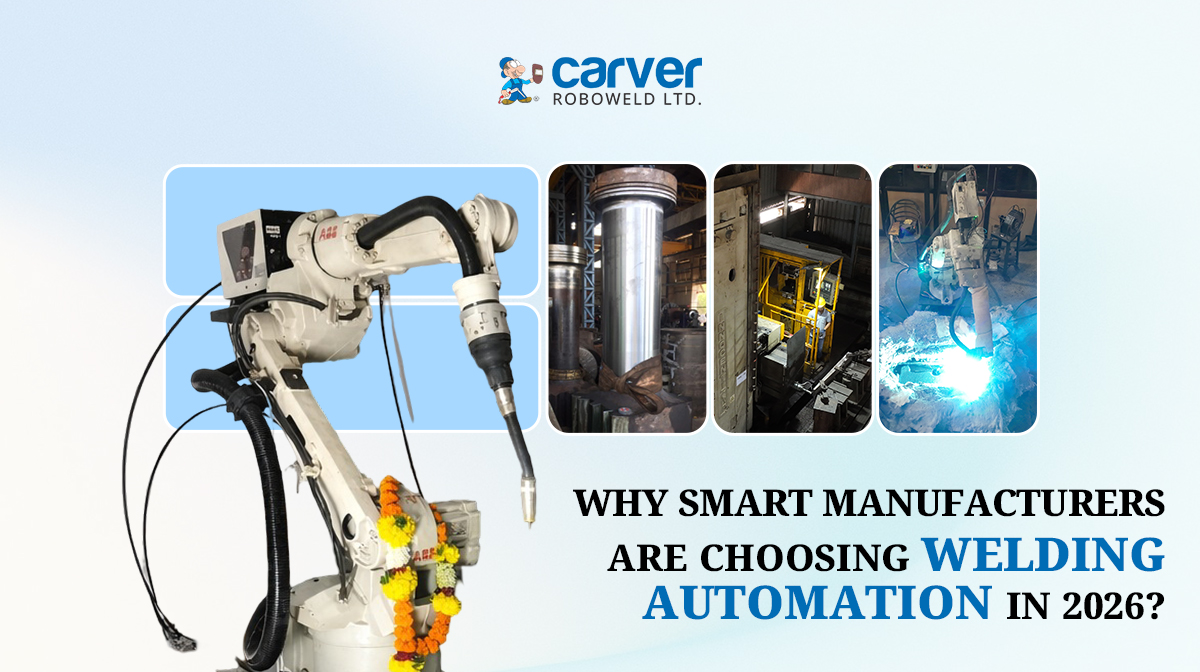
Why Smart Manufacturers Are Choosing Welding Automation in 2026

The welding automation market has become essential for advanced manufacturers since 2026 after they initially considered it an optional technology. Companies that use robotic welding systems in heavy industry and automotive assembly and precision fabrication sectors achieve better productivity and lower costs while delivering higher product quality than their rivals. The Carver RoboWeld facility leads the industry with its robotic welding solutions and complete manufacturing services which show us how welding automation transforms industrial processes while providing businesses with sustained development opportunities. The article examines the reasons which lead modern manufacturers to adopt welding automation while showing how this new trend matches current global manufacturing requirements.

The Industrial Context: Why 2026 Marks a Tipping Point

Welding automation adoption follows macroeconomic trends which drive manufacturing operations to adopt new automated systems:

1.The world needs more high quality products which manufacturers should produce in large quantities.

Manufacturers face continuous demands to produce higher quantities of products within reduced timeframes. The automated welding systems deliver better production capacity and operational uniformity which manual methods fail to achieve.

2.Skilled labor shortages and rising workforce costs

Welding exists as a traditional artisanal skill which needs extensive manual crafting for people to learn. The reduction of skilled welders in various regions creates a situation where businesses must automate their operations to maintain their workflows.

3.Required regulations and safety standards

The tightening of workplace health rules has led to faster adoption of automated systems for dangerous tasks which protect workers from welding arc exposure and harmful fumes and extreme heat.

4.Technological maturation of automation hardware and software

The development of welding automation systems now progresses through sensor technology and AI powered process controls and modular robotic systems which provide manufacturers of all sizes with automated welding solutions that work without any complications.

Core Advantages Driving Adoption

1. Dramatic Gains in Productivity and Throughput

The operating capabilities of automated welding systems permit continuous operation without showing any signs of exhaustion which human workers typically experience. Robots running throughout the day and throughout the night maintain stable operations which results in increased production rates and reduced equipment downtime during manufacturing procedures. The system handles operational tasks throughout the day which results in operational output increases which organizations need to achieve their production targets during busy periods of their operational calendar.

Non value added time for manual welding operations decreases when work on welding automation systems begins. The outcome produces more welds every shift together with improved operational speed and their work schedule becomes easier to foresee.

The automated welding systems create a welding process that enables manufacturers to achieve operational excellence through their precise welding capabilities which consistently maintain complete welding quality.

2. Unmatched Precision and Consistency in Weld Quality

In industrial welding applications particularly automotive and heavy equipment manufacturing repeatability and quality are paramount. Automated welding systems maintain exact arc paths, consistent heat input, and precise torch placement across thousands of cycles, eliminating the variability inherent in manual welding.

The product consistency results in improved product quality which leads to reduced operational costs through less need for rework and scrap materials. The implementation of robotic welding systems serves as the essential component which manufacturers need to achieve ISO standards and their specific industry requirements for quality control.

3. Long Term Cost Efficiency

The total cost of ownership to operate robotic welding cells over their lifetime generates strong return on investment because their initial capital costs require substantial investment.

  • Reduced labor costs: Automation diminishes dependence on large welding crews for repetitive tasks.
  • Lower material waste: Precise control of heat input and filler metal deposition reduces excess consumption and scrap.
  • Minimized rework and defects: Consistent quality lowers defect related expenses and warranty claims.

The total lifecycle cost of automated welding systems proves to be substantially lower than manual welding systems when production runs reach extensive scale according to manufacturing reports.

4. Enhanced Workplace Safety

Welding creates dangerous conditions because it produces extreme heat and ultraviolet radiation and airborne particles and hazardous chemical emissions. Robotic welding cells maintain a secure environment by keeping dangerous materials inside designated work areas which decreases the risk of human contact with these hazards.

The implementation of automation protects workers while it enhances workplace safety procedures which results in reduced workplace accidents and decreased costs for workers who receive compensation. Automated welding systems provide safety benefits that support ESG (environmental, social, governance) performance goals which organizations need to achieve.

5. Operational Flexibility and Scalability

The modern welding automation systems which manufacturers use today employ modular design. The system design allows manufacturers to adapt their production processes according to the requirements of different product lines and batch sizes and design variations.

Robotic cells include intuitive programming interfaces which enable operators to switch between different tasks without needing lengthy downtime or additional engineering work.

Manufacturers gain competitive advantages in ever changing market conditions through this flexibility which allows them to quickly switch between making different product variants or introducing new products.

Emerging Trends in Welding Automation for 2026

Automation trends emerge through several technological developments which show ongoing progress toward automated systems.

  • AI Driven Adaptive Welding – The combination of machine vision technology and artificial intelligence allows operators to change welding paths and heat profiles and material properties in order to enhance their performance on complex assembly tasks.
  • Collaborative Robots (Cobots) – Cobots enable human teams to work together because they need fewer safety measures and physical setups but they can handle light to moderate welding operations.
  • Digital Twins and Real Time Monitoring – Connected welding systems use predictive analytics which enables them to maintain equipment through automatic maintenance activities and continuous process improvements.
  •  Advanced Materials Welding – The automotive and aerospace industries now use lightweight and composite materials which require automated welding technologies to achieve the necessary precision for their next generation products.

The manufacturing process gains future advanced solutions through these innovations which boost operational efficiency.

Carver RoboWeld’s Role in Welding Automation

Carver RoboWeld provides automation solutions which match the specific needs of different customers. The company develops industrial solutions which fulfill precise operational needs through its heavy duty robotic welding systems and complete deployment support services.

Custom Configured Robotic Cells: The system enables businesses to achieve operational efficiency from the first day through its development of robotic cells which match their unique welding requirements and production needs.

Precision Engineering: Our robotic systems deliver repeatability and accuracy that meet the strict quality expectations of automotive, heavy machinery, and structural fabrication industries.

End to End Support: The company provides complete support to manufacturers which includes programming and installation as well as maintenance and optimization throughout their entire automation development process.

Carver RoboWeld uses its industry knowledge and dedication to research and development to assist manufacturers who want to achieve better results through improved quality and productivity and enhanced safety.

Conclusion: Welding Automation as a Competitive Advantage

The year 2026 establishes welding automation as an essential operational method which enables businesses to compete in their respective markets. The implementation of robotic welding systems provides manufacturers with the following advantages:

  • Accelerated production speeds
  • Superior and consistent quality
  • Lower long term costs
  • Safer work environments
  • Greater operational flexibility

Welding automation offers industrial leaders who prioritize growth and operational efficiency and organizational resilience a direct path to achieve their objectives. The team at Carver RoboWeld collaborates with manufacturers to ensure their transition process operates smoothly while our advanced welding automation systems power their future manufacturing facilities.