Nov 2026



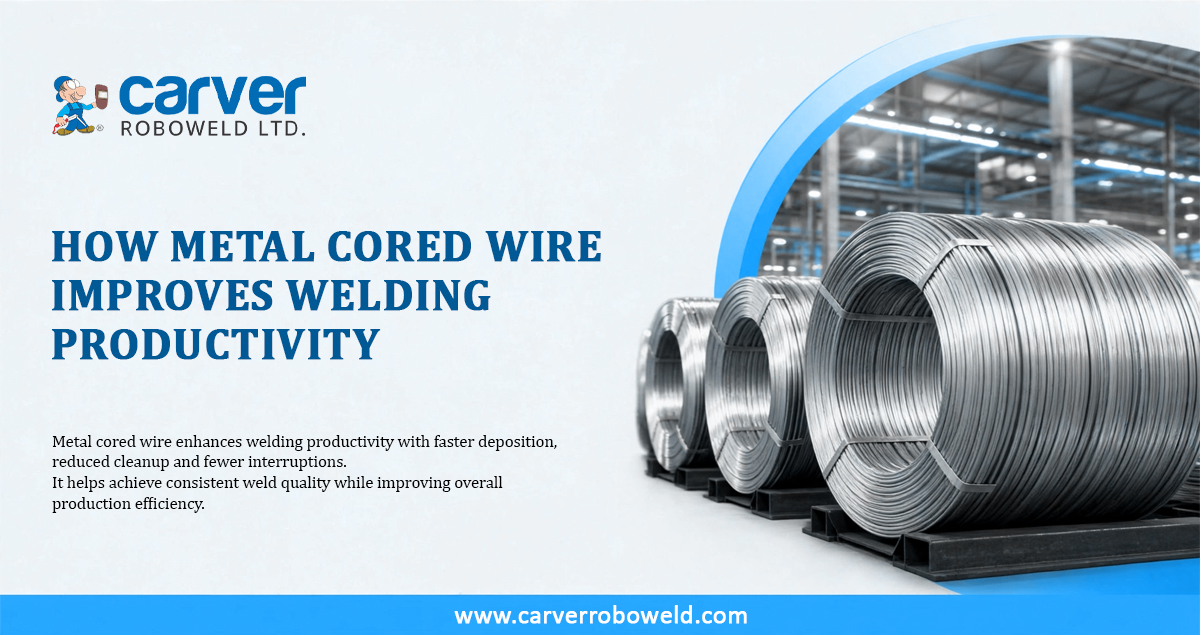
The welding arc goes out, and the clock keeps running. Someone has to remove the spatter, check the bead, move the part, prepare the next joint and, occasionally, repair a weld that did not meet requirements. On a busy production line, those minutes can add up to more than the time spent welding.
That is why improving productivity is not simply about making the torch travel faster. It is about producing an acceptable weld with less interruption and less work around the arc. For the right application, metal cored wire can help do exactly that.
At Carver Robo Weld, we supply metal cored wire for joining and build up work, including applications that use robotic welding. To understand where it can make a difference, it helps to look at both the wire itself and the entire welding cycle, not just the bead it leaves behind.
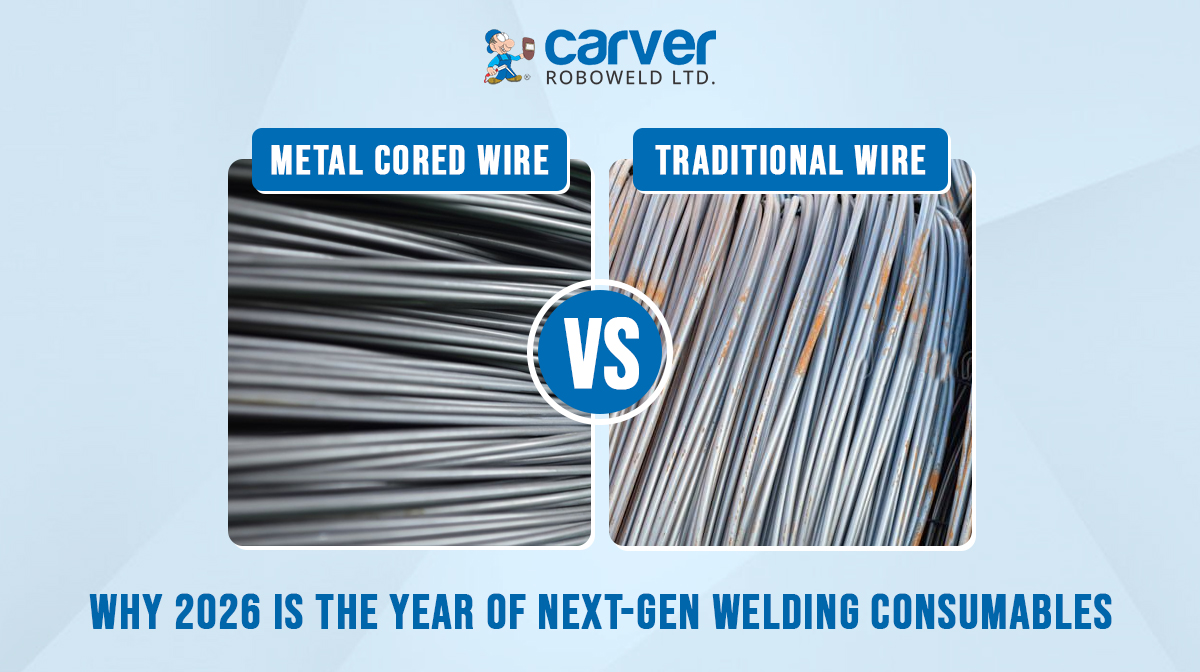
Metal cored wire is not solid all the way through. It has a metal sheath surrounding a core of metallic powders and alloying materials. That construction changes how the wire behaves in the arc and can allow it to deposit weld metal at a higher rate than a comparable solid wire under suitable conditions.
Deposition rate matters because it affects how long it takes to fill a joint or build up a surface. If the required weld can be made at a faster travel speed while still meeting its quality requirements, a welder or robot can complete that operation sooner and move on to the next part. In one published comparison at the same current and wire diameter, metal cored wire delivered a higher deposition rate than solid wire. That is a useful demonstration of the potential not a promise that every workshop will see the same gain.
Think of a repetitive fabrication job with the same weld appearing on hundreds of components. Saving a little time on one component may seem unremarkable. Repeating that saving throughout a shift can change how many finished parts leave the welding station. The important condition is that the faster weld must still satisfy the joint’s requirements. Speed that creates rework is not productivity.
A completed bead is not always a completed job. Spatter may have to be removed before a part is assembled, inspected or finished. In multi pass welding, slag between passes can interrupt the sequence. Each extra step takes labour and keeps the next operation waiting.
Metal cored wire can produce low spatter and little slag when used with an appropriate process and settings. That can reduce post weld cleaning and make it particularly useful in automated multi pass work, where stopping between passes defeats some of the benefits of automation. These are application dependent advantages, not reasons to skip proper surface preparation or inspection.
Consider a part that must move from welding to finishing. A faster bead helps, but so does a part that arrives without extensive spatter removal. The time saved may not appear in the welding program at all; it shows up at the next workstation.
Robotic welding is built around consistency. The robot follows a programmed path, but the process still depends on stable wire feeding, suitable parameters and a joint that can be welded as planned. When those pieces work together, metal cored wire’s deposition and low cleanup characteristics can support shorter, more repeatable cycles. Carver Robo Weld identifies robotic compatibility, consistent bead geometry and reduced cleaning downtime among the advantages of its metal cored wire range.
There is a useful distinction here: a robot repeats what it has been taught; it does not decide whether a faster weld is sound. A change from solid wire to metal cored wire should therefore be tested on the actual joint. Travel speed, voltage, wire feed speed, shielding gas and torch position may all need attention. If the part is welded under a qualified procedure, a wire change may also require procedure review or requalification.
Once the process is proven, even small reductions in cycle time or cleanup can be valuable when the same weld is repeated throughout the day. That is where the case for metal cored wire is often strongest: not as a shortcut, but as part of a carefully controlled production system.
It is easy to count the time spent making a weld. The time spent remaking one is harder to ignore.
Metal cored wire can offer a stable arc and, in suitable applications, help bridge variations in joint fit up. Those characteristics may reduce some quality problems and the repairs that follow. But no wire makes poor preparation irrelevant. Joint design, base metal condition, shielding and correct settings still determine whether the finished weld is acceptable.
The goal is not to weld through every problem on the production floor. It is to choose a process that performs reliably within the real conditions of that job and then measure whether scrap and rework improve.
Metal cored wire generally costs more per unit of weight than solid wire, so a purchase price comparison tells only part of the story. A useful comparison includes the time spent welding, cleaning and repairing; the amount of acceptable weld metal deposited; and the number of finished parts the operation can actually process. It should also account for equipment capability and what happens downstream. Faster welding offers limited benefit if the next station cannot handle more parts.
Nor is metal cored wire automatically the best choice for every weld. Welding position, shielding gas requirements, material, joint geometry and available equipment all affect the decision. The sensible approach is to trial it on a representative part, compare results with the current process and confirm weld quality before changing production.
At Carver Robo Weld, we see welding productivity as more than arc speed. It is the ability to make the required weld, move the part forward and do it again with confidence. When metal cored wire is matched to the application and its parameters are properly developed, the improvement can reach well beyond the welding station: more time spent making sound welds and less time spent dealing with what comes after them.